This year, America celebrates 250 years since the signing of the Declaration of Independence.
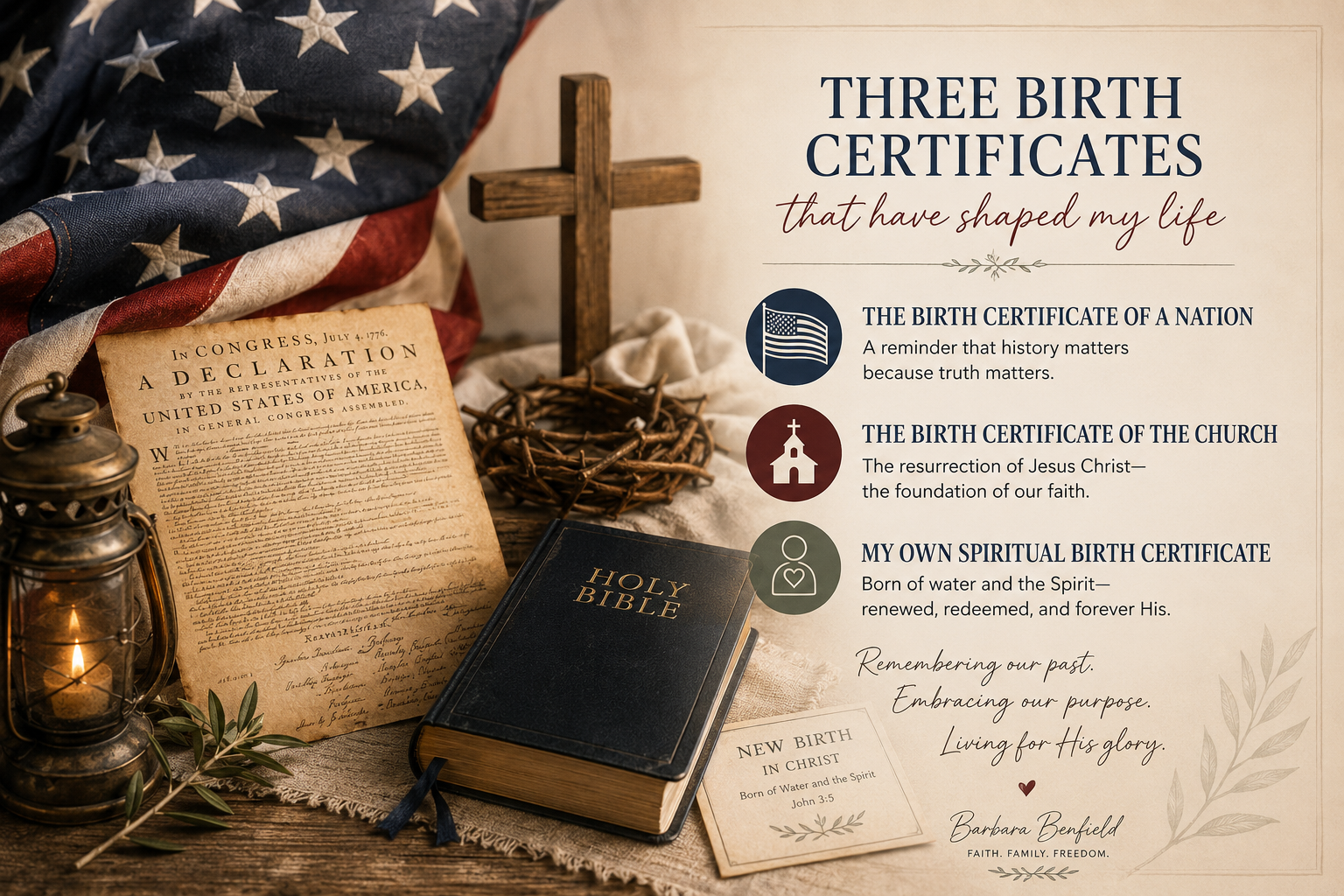
As I have reflected on that milestone, I found myself thinking about three birth certificates that have profoundly shaped my life.
The first is the birth certificate of a nation.
The second is the birth certificate of the Church.
The third is my own spiritual birth certificate.
Each one reminds me that history matters because truth matters.
Recently, as we approached America’s 250th anniversary, I learned that Hillsdale College partnered with the White House to produce a series of videos commemorating the events that led to our nation’s founding. Whether you agree with every decision made throughout our history or not, remembering our past does not require us to pretend it was perfect. Nor does it require us to view it only through the lens of its failures.
History deserves better than either romanticism or condemnation.
Remembering the courage, sacrifice, faith, and determination of those who came before us helps us understand how fragile freedom really is. Human flourishing has always depended upon people willing to exercise self-government, embrace personal responsibility, and bind themselves freely to a common good.
Our nation has a birth certificate.
But there is another birth certificate that matters infinitely more.
The resurrection of Jesus Christ has often been called the birth certificate of the Christian Church. The resurrection is not merely one event among many in the Bible. It is the culmination of God’s redemptive plan. From Genesis to Revelation, Scripture points to the life, death, burial, and resurrection of Jesus Christ.
If Christ did not rise, Christianity collapses.
If He did rise, everything changes.
The resurrection validates Jesus’ claims about Himself. It demonstrates that death is not the end, that sin has been defeated, and that eternal life is offered to all who repent and believe.
What has always fascinated me is that even many skeptical scholars acknowledge the remarkable historical evidence surrounding the resurrection. Philosopher Douglas Groothuis points to the extensive work of N. T. Wright, whose careful examination of the New Testament documents concludes they are historically reliable concerning the resurrection.
Perhaps even more striking is the observation made by the late philosopher Anthony Flew. Though he ultimately embraced only a minimal form of theism and never accepted Christianity, he nevertheless admitted:
“The evidence for the resurrection is better than for claimed miracles in any other religion.”
That statement has always amazed me. It reminds us that disbelief is not always the result of insufficient evidence. Sometimes it reflects deeper philosophical commitments about what one is willing to believe.
The resurrection also explains something history cannot easily explain otherwise: the birth of the Church itself.
Jesus’ disciples were devastated after His crucifixion. They hid in fear. Some doubted the testimony of the very women who first proclaimed that Christ had risen. Yet within days these same frightened followers became fearless witnesses who willingly endured persecution and death rather than deny what they had seen.
As New Testament scholar F. D. Moule observed, the rapid rise of Christianity remains an unsolved puzzle for anyone unwilling to accept the explanation the Church itself has always given—that Jesus truly rose from the dead.
Alternative explanations have been proposed over the centuries. Some suggest hallucinations. Others propose conspiracy, a stolen body, or fabricated accounts.
Yet each theory struggles under the weight of the historical evidence.
Hallucinations are individual experiences, not group events witnessed by many people over an extended period. Conspiracies collapse under pressure, yet the apostles consistently suffered imprisonment, torture, and death without abandoning their testimony. As Pascal wisely observed, the human heart is too weak to sustain a deliberate lie under such relentless suffering.
Jewish scholar Pinchas Lapide perhaps summarized it best:
“If the defeated and depressed group of disciples overnight could change into a victorious movement of faith… based only on self-deception… then this would be a much greater miracle than the resurrection itself.”
The resurrection remains the best explanation because it is the explanation that best fits all the evidence.
But for me, this story is not merely historical.
It is deeply personal.
On August 27, 2006, I walked to the altar at Covington Church and surrendered my life to Jesus Christ. God, in His mercy, did what I could never do for myself. He regenerated my heart, granting me repentance and faith—not because of any righteousness of my own, “but according to His mercy, by the washing of regeneration and renewing by the Holy Spirit” (Titus 3:5, LSB).
Nearly twenty years later, I sat in that very same church and watched my daughter be baptized. Afterward, the pastor invited her to the front of the congregation, where she publicly declared, “Jesus is my Lord and Savior.” Her words reminded me of the beautiful truth found in Romans 10:9–10—that genuine faith in the heart is joyfully confessed with the mouth.
The place where God graciously drew me to Himself had become the place where I watched Him continue His work in the next generation.
Pastor Isaacs at Crest View Baptist recently reminded us that we usually recognize God’s providence by looking backward, not forward.
How true that is.
Rarely do we understand what God is doing while we are living through it. But when we pause to look back, we begin to see His fingerprints across the years.
This Fourth of July, I am grateful for America’s birth certificate and the freedoms so many sacrificed to preserve.
Far more, I am grateful for the empty tomb — the birth certificate of the Church and the foundation of our hope.
And most personally of all, I am grateful that, by God’s grace, He regenerated my heart, granted me repentance and faith, and made me alive in Christ.
History matters.
But redemption matters forever.
Leave a Reply